From Awareness to Capability
From Awareness to Capability
Practical Mental Health and Resilience Training for Regional Workplaces
Regional workplaces are carrying more pressure than ever.
Leaders are managing complex teams, changing expectations, mental health concerns, psychosocial hazards, compliance responsibilities and the everyday reality of people working under stress.
Most workplaces want to support their people well. Many already have policies, Employee Assistance Programs, wellbeing initiatives and safety systems in place. These all play an important role in building healthier workplaces.
The next step is capability.
Awareness helps people understand that mental health, psychological safety and resilience matter. Capability gives them the practical skills to respond when those issues show up in real workplace moments.
This is where Mental Health First Aid, Resilience First Aid and High Adversity Resilience Training can make a meaningful difference.
Awareness is important, but skills create action
Over recent years, more organisations have started talking about mental health, psychosocial hazards, resilience and psychological safety. These conversations are important because they help reduce silence, increase understanding and encourage workplaces to take wellbeing more seriously.
At the same time, awareness alone does not always help a manager know what to do when someone is struggling.
A leader may understand that mental health matters, but still feel unsure about how to start a conversation. A team may know resilience is important, but still lack practical strategies for managing pressure. A workplace may have policies in place, but still need stronger everyday behaviours that support psychological safety.
Capability fills that gap.
It gives people shared language, clear frameworks and practical tools they can apply in real situations. It helps workplaces move beyond knowing these issues matter and into building the confidence to act earlier, more safely and more effectively.
Regional workplaces need practical and human support
Regional workplaces often face pressures that require a practical and grounded approach.
Teams may be smaller, managers may hold multiple roles, and access to professional support can vary depending on location. In many regional and rural communities, people also know each other outside work, which can make speaking up more complex.
These realities matter when designing training and support.
A one-size-fits-all approach does not always land in regional workplaces. People need training that understands limited resources, close community connections, dispersed teams and the need for clear, human-first solutions.
The most useful training gives people tools they can practise and use. It also recognises that workplace wellbeing is shaped by everyday conversations, repeated behaviours and the way leaders respond when people are under pressure.
EAPs are valuable, and internal capability still matters
Employee Assistance Programs provide an important layer of professional support. Many EAP providers do valuable work with individuals and workplaces, often supporting people through difficult and complex situations.
The opportunity for workplaces is to build internal capability alongside those professional supports.
Often, the first sign that someone may need help appears inside the workplace. A manager may notice a change in behaviour. A colleague may sense that someone is not coping. A supervisor may be present after a difficult shift, incident or conversation.
In those early moments, people need to know how to respond safely.
Internal training does not replace professional support. It helps people recognise when support may be needed, respond with care and guide someone towards appropriate help. When internal capability and professional support work together, workplaces are better placed to support people earlier.
Mental Health First Aid supports safer conversations
Mental Health First Aid helps people recognise and respond when someone may be experiencing a mental health concern or crisis.
This is practical first-response training. It does not ask managers, supervisors or colleagues to become counsellors. Instead, it gives participants a structured framework for noticing signs, offering initial support and guiding someone towards professional help.
This training can be valuable for managers, supervisors, team leaders, WHS teams, HR or P&C teams, and anyone who may be in a position to notice when someone is struggling.
In a workplace setting, mental health concerns may not always be obvious. Someone may withdraw, become more reactive, lose confidence, stop contributing, miss deadlines or repeatedly say they are fine when their behaviour suggests otherwise.
Mental Health First Aid helps people approach those moments with more confidence and care. It supports safer conversations and helps reduce the uncertainty that often stops people from saying anything at all.
Resilience First Aid builds proactive support skills
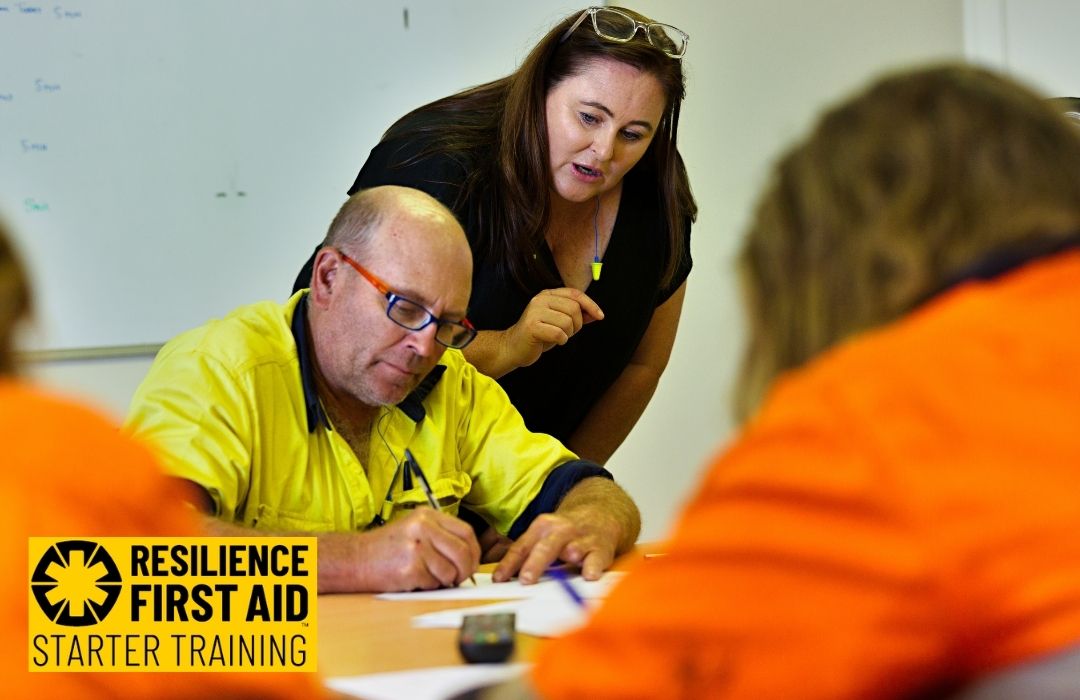
Resilience First Aid is a strong fit for workplaces that want to take a more proactive approach to mental health, wellbeing and culture.
This training helps people understand resilience as a practical skill, not simply an expectation to keep coping. It supports individuals and teams to recognise pressure, build protective factors and strengthen the way they respond to challenges.
Resilience First Aid is built around six domains:
Vision
Composure
Reasoning
Health
Tenacity
Collaboration
These domains provide a practical framework for understanding resilience in a more complete way. They help people explore how they think, respond, connect, recover and continue moving through pressure with greater awareness and skill.
This matters because culture is shaped by repeated behaviour.
The way leaders respond to concerns, the quality of conversations after difficult moments, the way people recover from pressure and the support offered before someone reaches crisis point all influence workplace culture.
Resilience First Aid helps workplaces build the skills and shared language needed for more constructive conversations, stronger support and more intentional workplace wellbeing.
High Adversity Resilience Training supports high-pressure environments
High Adversity Resilience Training sits slightly differently within the broader capability pathway.
It is designed for people who work in high-pressure roles or environments where stress, adversity, trauma, conflict or challenging situations are part of the work.
This may include emergency services, frontline teams, health, aged care, allied health, schools, community services, mining, quarrying and leadership roles where people are regularly required to respond under pressure.
HART builds advanced resilience skills and practical strategies for managing high-stress environments. It helps participants understand stress and trauma, recognise early signs that support may be needed, and apply effective responder protocols.
For some workplaces, Mental Health First Aid or Resilience First Aid may be the best starting point. For others, especially those with teams exposed to repeated adversity or high-pressure situations, HART may provide the next level of training and support.
Prevention should come before repair
Workplaces are often forced into action after something has already happened.
A complaint is lodged. A team member burns out. A leader realises people are not speaking up. An incident occurs. A high-pressure period leaves the team exhausted and reactive.
At that point, support is still important, but the workplace is already responding late.
A preventive approach builds skills earlier.
It helps people recognise changes sooner, respond with greater care and create support pathways before they are urgently needed. It also helps leaders and teams understand that wellbeing, resilience and psychological safety are part of everyday workplace culture, not occasional conversations held only during crisis.
This shift from awareness to capability is where meaningful change begins.
Why BLMC
BLMC supports regional workplaces to build safer, healthier and more resilient teams.
Bjelkie Lansdown brings more than 30 years of experience across HR, WHS and workers compensation, along with a deep understanding of the human side of workplace safety. Her work blends WHS requirements with human behaviour, neuroscience and practical learning design to create training that is relevant, grounded and useful.
Bjelkie’s approach is professional, practical and human. She understands that people need practical and clear information. They need tools they can practise, language they can use and training that reflects the real pressure of their work environment.
Her work is grounded in the belief that every person deserves to be physically and psychologically safe at work. It also recognises that workplaces need clear, practical support to make that possible.
Choosing the right training for your workplace
Mental Health First Aid may be the right fit if your workplace wants people to feel more confident recognising and responding when someone may not be okay.
Resilience First Aid may be the right fit if your workplace wants to build proactive resilience skills, strengthen support and create more constructive conversations across the team.
High Adversity Resilience Training may be the right fit if your people work in high-pressure environments and need advanced skills to respond to stress, adversity and trauma.
Each course supports a broader goal of building safer conversations, stronger support and more confident responses when people are under pressure.
Build capability before it is urgently needed
Mental health, resilience and psychological safety are now part of building safer and stronger workplaces.
Policies, awareness, EAPs and wellbeing initiatives all have an important role to play. Practical training strengthens those supports by helping people know what to do when the moment arrives.
Regional workplaces need leaders and teams who can notice, listen, respond and guide others towards support. They also need training that reflects the realities of their people, their pressure and their environment.
BLMC’s public training courses are now open.
To explore upcoming Mental Health First Aid, Resilience First Aid and High Adversity Resilience Training options, visit the BLMC website and book your place.